

 All posts

Jet engines transformed aviation. They made long-haul flights faster, smoother, and more comfortable and continue to evolve. At SHY Aviation, every private charter we arrange is powered by decades of engineering breakthroughs. Understanding where jet engines came from explains why they’re still at the core of high-performance travel today.

The beginning: from concept to reality

In the early 20th century, aircraft used piston engines - heavy, loud, and limited in speed and range. Then, in 1930, RAF officer and engineer Frank Whittle applied for a patent for a new type of propulsion: the gas turbine jet engine. His design compressed air, mixed it with fuel, ignited it, and used the hot gases to produce forward thrust.
Despite the potential, there was little support in the UK. Whittle’s patent lapsed in 1935 because he couldn’t pay the £5 renewal fee.
Meanwhile in Germany, Hans von Ohain was working on a similar concept. Funded by aircraft designer Ernst Heinkel, von Ohain’s team created the Heinkel He178 - the first aircraft powered by a jet engine. It flew in 1939, marking the start of a new era.
Britain’s first successful jet-powered flight came in 1941 with the Gloster E.28/39, based on Whittle’s design. The United States followed with the Bell XP-59A in 1942.
Jet power in war

By the end of WWII, jet-powered aircraft were used in combat. The Messerschmitt Me 262, introduced by Germany in 1944, was the first operational jet fighter. With speeds far above any piston-engine aircraft, it offered a glimpse into aviation’s future.
Although jet aircraft didn’t significantly change the outcome of the war, they made it clear that propeller-driven designs were nearing their limits. The Me 262 outpaced Allied fighters with ease, but its impact was limited by late deployment, reliability issues, and a lack of trained pilots.
Elsewhere, the UK deployed its own jet-powered fighter, the Gloster Meteor, mainly to intercept V-1 flying bombs. Meanwhile, the US developed the Bell XP-59A, its first jet aircraft, in 1942 though it never saw combat.
These early jet aircraft had short range, high fuel consumption, and handling challenges. Still, they marked a turning point. By the war’s end, it was clear that jet propulsion would define the next generation of military and commercial flight. Investment surged across the US, UK, and Europe, setting the stage for the jet age.
Commercial aviation enters the jet age
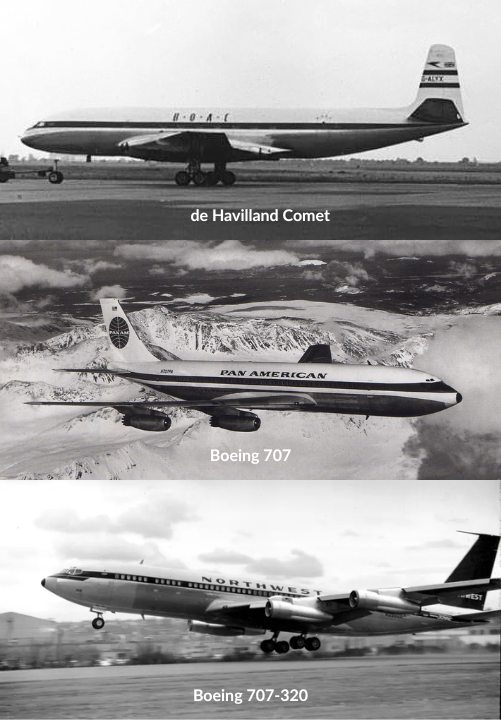
The first commercial jet airliner, the de Havilland Comet, entered service with BOAC in 1952. It cut flight times significantly and offered a quieter, smoother experience compared to piston aircraft. While early structural issues led to setbacks, the Comet proved that jet-powered passenger flight was not only possible but preferable.
The real shift came in 1958 when Pan American launched the first transatlantic jet service using the Boeing 707. It carried 111 passengers - a record at the time and completed the New York to London route in just over eight hours.
This marked the start of mainstream international jet travel. Extended-range versions like the 707-320 followed quickly, removing the need for stopovers and setting new expectations for global mobility. The jet engine had moved from military use to the core of commercial aviation.
Types of jet engines

Jet engines are not one-size-fits-all. Over time, engineers developed several types:
-
Turbojets – The original design. Efficient at high speeds but fuel-intensive and loud.
-
Turboprops – A jet engine driving a propeller. Ideal for short-haul and cargo aircraft.

-
Turbofans – A jet engine with a large fan that produces extra thrust. Most commercial and private jets today use this design.
-
Ramjets – High-speed engines with no moving parts. Used in missiles and some military applications.
The turbofan is the engine of choice for today’s business jets. It draws in massive volumes of air, compresses part of it for combustion, and bypasses the rest around the core. The result is quieter performance, reduced fuel burn, and the ability to operate from shorter runways, all essential in private aviation.
Jet engines in private aviation

Modern private jets are powered by turbofan engines built for high efficiency, low noise, and long-range performance. These engines allow aircraft to cover intercontinental distances quickly, operate from shorter runways, and provide a quieter, more comfortable cabin experience.
Key engine manufacturers include:
-
Rolls-Royce – Powers the Gulfstream G650, Bombardier Global 6000, and other long-range jets. Known for reliability and performance.
-
General Electric (GE) – Supplies the Passport engine for the Global 7500 and the CF34 for Embraer and Challenger aircraft.
-
Pratt & Whitney – Makes the PW300 and PW800 series, used on Dassault, Gulfstream, and Bombardier jets.
-
CFM International – Produces the LEAP engine, widely used in commercial aviation and adapted for some larger VIP aircraft.
These engines make private aviation faster, more flexible, and more accessible supporting global travel with fewer stopovers and shorter flight times.
Advancements in technology

Jet engines are constantly evolving. While the basic cycle remains the same air intake, compression, combustion, and exhaust the materials, designs, and controls have improved dramatically. New developments include:
-
UltraFan (Rolls-Royce) – A next-generation turbofan engine with carbon composite blades and a geared design. Promises 25% greater fuel efficiency.
-
GE9X – The most fuel-efficient jet engine GE has ever produced, designed for the Boeing 777X.
-
Lighter materials – Titanium, carbon fibre, and ceramic matrix composites reduce engine weight and increase durability.
-
Digital engine control systems – Improve response, safety, and maintenance tracking.
These advances translate into better fuel economy, fewer emissions, quieter operation, and longer range all critical for modern private jet performance.
What this means for SHY Aviation clients

Jet engines are at the heart of private aviation. Their evolution allows SHY Aviation to offer aircraft that are:
-
High-speed travel with minimal ground time
-
Long-range capability for non-stop international flights
-
Quieter cabins for productive, restful journeys
-
Access to a wide range of airports, including those with short runways
- A clear path toward more sustainable flying
Whether flying short-haul or intercontinental, every SHY Aviation private jet charter is powered by decades of engineering excellence. Our aircraft are selected based on performance, range, and comfort made possible by jet engine technology that keeps improving.
Contact us today to find out more about our charter services and how we can help revolutionise the way you travel.
Do not hesitate to visit our online quote to obtain a price estimate for your next journey.
Request a quote