
 All posts

The French government is introducing a new tax that will affect all flights departing from France and its territories. The French Solidarity Tax, or Taxe de solidarité sur les billets d'avion (TSBA), will come into effect on 1st March 2025 and will apply to both private and commercial aviation. This initiative is designed to support sustainability efforts while shaping the future of air travel.

What is the French Solidarity Tax?
The French government is introducing this tax to raise funds for environmental projects and encourage more sustainable aviation. This means that all passengers flying from France will now be required to pay an additional charge, with some exemptions available for specific routes.
How is the Tax Calculated?
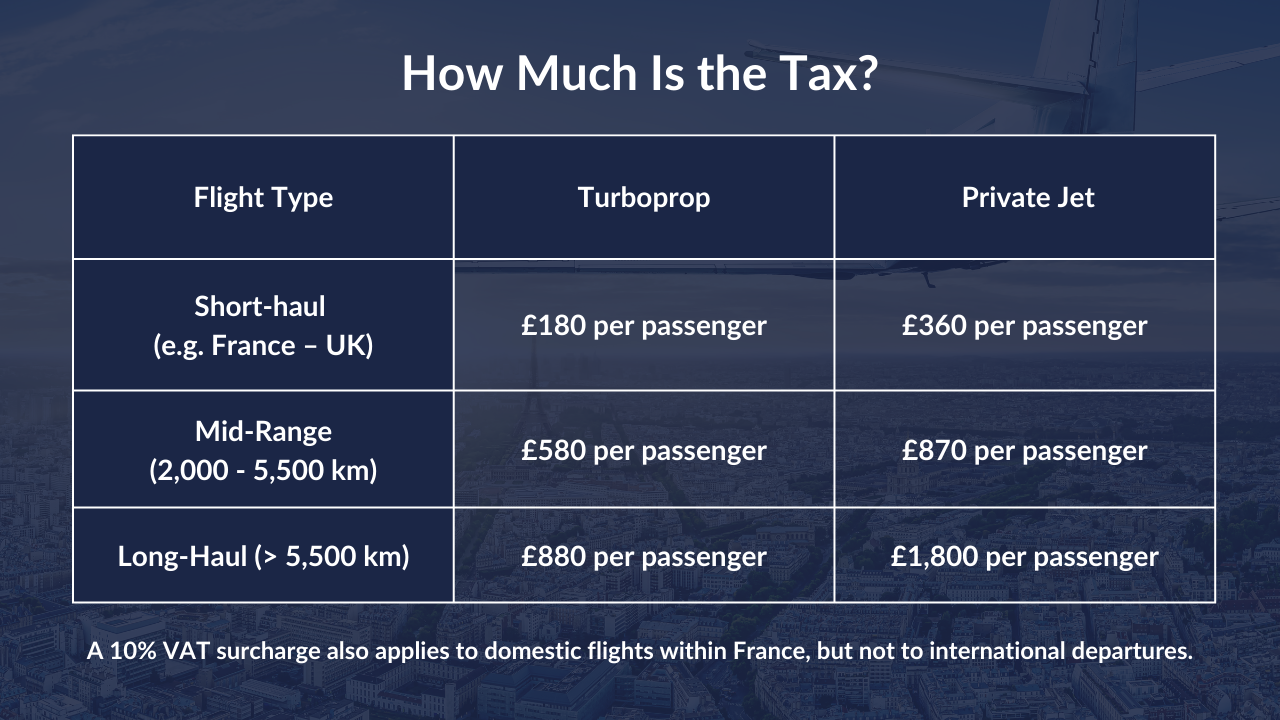
Previously, flights were taxed under two bands of destinations; the 2025 reform introduces a three-band structurebased on flight distance:
-
Short-haul: European Economic Area (EEA) and countries with a capital airport within 1,000 km of Paris Charles de Gaulle (Paris Charles de Gaulle Airport (CDG)) (e.g. UK, Switzerland).
-
Mid-range: Destinations that do not fall under short-haul or long-haul categories.
-
Long-haul: Airports whose capitals are more than 5,500 km from CDG.
The tax structure now includes four categories of business aviation (previously two), distinguishing between commercial and private aviation:
-
Standard flights – general chartered flights.
-
With additional service – flights with extra onboard services charged separately.
-
Business aircraft (turboprop engines) – non-scheduled flights in turboprop aircraft with 19 or fewer seats.
-
Business aircraft (turbojet engines) – unscheduled operations using turbojet aircraft with 19 or fewer seats.
Why has this tax been introduced?

The French government has introduced this tax for two main reasons. The first is to raise funds for environmental projects, helping to support climate initiatives and promote cleaner aviation solutions. The second is to encourage the use of Sustainable Aviation Fuels (SAF) by making traditional air travel more expensive. A 50% tax credit is available for companies using SAF, capped at £35 million per year.
How SHY Aviation Can help?
At SHY Aviation, we understand that these changes can make private travel more expensive. We help our clients find cost-effective routes, minimise tax exposure, and ensure compliance with new regulations.
Our services include transparent pricing, where all taxes are included upfront, regulatory guidance to keep clients informed, and personalised itinerary planning to help find the best routes and aircraft for cost savings.
Need Help Planning Your Next Flight?
If you're looking for ways to reduce costs or find better departure options, contact SHY Aviation today. Our team is here to make your private jet experience as smooth and affordable as possible.
Do not hesitate to visit our online quote to obtain a price estimate for your next journey.
Request a quote